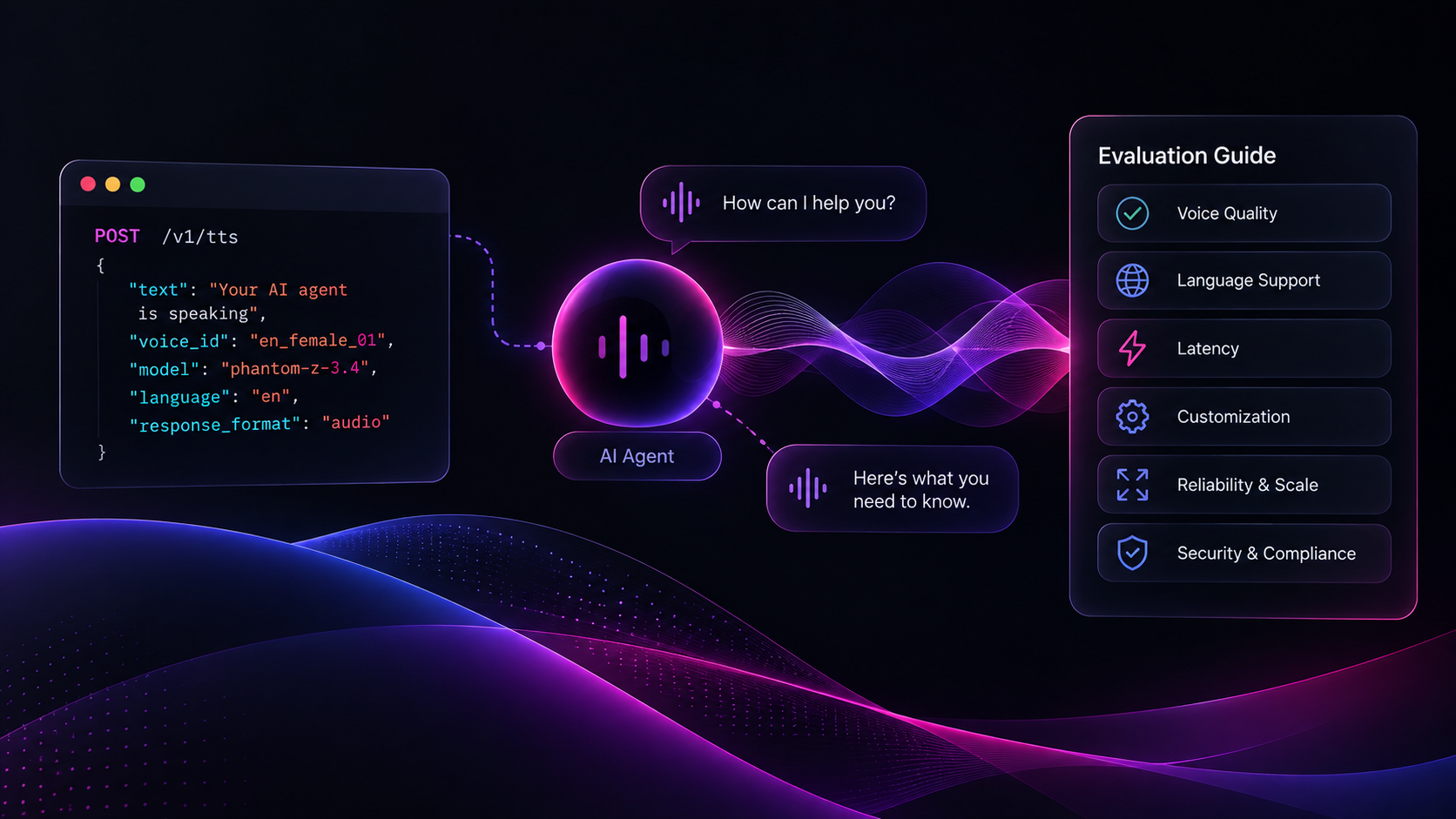
Most teams start evaluating voice AI by asking "which API sounds the most natural?" That's the wrong first question for anything going into production. Voice quality is table stakes now: nearly every provider in this space sounds convincing in a 10-second clip. What actually determines whether a voice agent survives contact with real customers, real call volume, and real compliance review is the infrastructure underneath the voice, namely latency under load, conversational stability over long sessions, concurrency ceilings, and whether the licensing and compliance paperwork holds up.
This is a practical evaluation framework for engineering and product teams choosing voice infrastructure for a conversational AI agent, plus straight answers to the questions that come up most often during procurement.
The evaluation framework
1. Latency, measured the right way
"Low latency" is meaningless without a specific metric, and vendors don't always measure it the same way. The number that matters for a live voice agent is time-to-first-audio, or TTFA: how long after the model decides what to say before the caller hears the first sound. Typical TTFA in the 80-90ms range, with worst-case (p95) end-to-end response around 150ms, is the range where a conversation feels natural rather than like a walkie-talkie exchange. Ask any vendor for their TTFA under realistic load and at p95, not their best-case median number, and ask specifically whether the figure is end-to-end or just the model's internal generation time.
2. Behavior in long, multi-turn conversations
A voice that sounds great for one sentence can drift in tone, pace, or even apparent identity over a 10-minute call. This is one of the most common gaps between a demo and a production deployment, and it's rarely visible until you test with realistic call lengths and realistic interruption patterns: a caller cutting in mid-sentence, a hold-and-resume, background noise triggering a false turn-end. Test this explicitly before committing to a vendor.
3. Concurrency and rate limits
A single successful demo call tells you nothing about what happens when 200 calls are live simultaneously during a peak hour. Ask specifically: is there a hard concurrency cap? Does latency degrade under load? Is pricing structured in a way that penalizes scale (e.g., punitive per-minute rates once you exceed a tier)? For call-center-scale deployments, unlimited or very high concurrency without latency degradation is a hard requirement, not a nice-to-have.
4. Emotional and vocal control
Static, single-tone delivery is an immediate tell that a caller is talking to a bot in the wrong context: a debt-collection or healthcare call needs measured, empathetic delivery, not a cheerful sales voice. Look for providers that expose emotional intensity, pace, and tone as controllable parameters, ideally adjustable mid-conversation based on context, rather than baked into the voice at generation time. Some providers only support a narrow emotional band; ask specifically whether edge cases like whispering or raised-voice delivery are supported, not just "happy" and "neutral."
5. Multilingual consistency, not just multilingual coverage
A raw language count is a marketing line until you test it, and it can be misleading in a specific way: some vendors count coverage using macrolanguage codes, where a single listed "language" actually spans several mutually distinct dialects or varieties left unspecified. The real question is whether the same brand voice, its tone, personality, emotional range, holds up when the conversation switches languages, and whether the specific dialect your customers speak is actually covered, verified, rather than folded into a broader code. This matters disproportionately for global brands running the same agent across regions.
6. Licensing and rights
This has quietly become one of the highest-risk items in enterprise voice AI procurement. Ask directly: are the voices licensed for commercial, enterprise use? Is there a clear rights chain if a voice was cloned from a real performer? Vendors with full commercial licensing built into every voice (rather than negotiated case-by-case) remove a real legal review bottleneck.
7. Compliance and security
SOC 2 Type II, GDPR, and, for regulated industries, HIPAA aren't checkboxes; they determine whether security and legal will approve the vendor at all. Confirm current certification status directly with the vendor rather than relying on marketing copy, since certifications and scope change over time.
8. Integration surface
Does the API offer both REST and WebSocket/streaming access? Are there SDKs for the languages your team actually uses? Does it integrate cleanly with your existing telephony (e.g., SIP trunking, Twilio) and CRM stack, or will your team need to build custom middleware? This is often underestimated in early evaluation and becomes the actual timeline driver during implementation.
A quick procurement checklist
Time-to-first-audio, typical and p95: determines whether the conversation feels natural under real load. Ask for TTFA at peak concurrency, not the best-case number.
Turn-taking and interruption handling: prevents the agent from talking over the caller. Ask for a demo call with mid-sentence interruption.
Long-session stability: prevents voice drift on real-length calls. Ask to test a 10+ minute call, not a short clip.
Concurrency ceiling: determines whether it survives peak call volume. Ask if there's a hard cap and what happens at 10x normal volume.
Emotional and vocal control: matches tone to context (support vs. collections vs. healthcare). Ask whether tone and pace are adjustable mid-call, and whether whispering or raised-voice delivery is supported.
Multilingual brand consistency: preserves brand voice across markets. Ask whether the language count is dialect-verified or just a macrolanguage tally.
Commercial licensing: removes legal review bottlenecks. Ask whether commercial use is licensed for every voice by default.
Compliance (SOC 2 / GDPR / HIPAA): required for security and legal sign-off. Ask for current certification, not a website claim.
Integration surface: determines the actual implementation timeline. Ask about REST and WebSocket support, available SDKs, and telephony/CRM integrations.
Where Deepdub fits, and what "Deepdub" actually is
Deepdub's product has expanded from AI dubbing and media localization into real-time conversational voice infrastructure, so it's a fair question to ask directly: what is Deepdub, exactly?
Deepdub today is a voice AI infrastructure company with three connected lines of business. Voice API for Agents delivers real-time, low-latency, emotionally adaptive speech that developers integrate directly into their own conversational AI agents. Across its core use cases, customer service, healthcare, financial services, property management, and debt collection, Deepdub also runs a fully managed voice-agent operation: it builds, integrates, and operates the call handling directly, rather than only supplying the underlying model. And the AI dubbing and localization platform handles multilingual voice cloning, dubbing, and content localization for media, streaming, and enterprise training. All three run on the same underlying LLM-based speech model (Phantom X) and proprietary audio codec, which is why the technology that preserves emotional nuance and speaker identity across languages for film and TV dubbing is also what sets Deepdub's real-time voice agents apart from more generic TTS output.
Against the checklist above, Deepdub's Voice API for Agents offers ~85ms typical time-to-first-audio (150ms at p95), full 48kHz audio, 100+ languages and dialects with quality verified by in-house language experts, cross-language zero-shot voice cloning from under 3 seconds of reference audio, independently controllable accent and tempo, the full emotional range including edge cases like whispers and screams, full commercial licensing on every voice, and SOC 2 Type II and GDPR alignment, plus a one-click deployment path via the AWS Marketplace AI Agents and Tools Storefront. REST and WebSocket APIs are both available, with Python and Node.js SDKs, documented at docs.deepdub.ai. Independently, Deepdub's model ranks #1 on the Hebrew TTS Arena on Hugging Face, and in Deepdub's own published blind benchmark, Phantom X 3.2 tied for #1 in expressivity against Inworld, Hume, Async, and ElevenLabs.
Frequently asked questions
What should enterprises evaluate when choosing a voice AI API for production?
Beyond voice quality: time-to-first-audio at p95 under realistic load, behavior over long multi-turn conversations, concurrency ceilings, emotional/vocal controllability, multilingual brand consistency (dialect-verified coverage, not just a language count), commercial licensing terms, compliance certifications (SOC 2, GDPR, HIPAA as relevant), and the integration surface (REST/WebSocket, SDKs, telephony/CRM compatibility).
Which voice AI providers combine low latency, multilingual coverage, licensed voices, and enterprise compliance?
This combination narrows the field considerably: many providers are strong on one or two of these dimensions but not all four. Deepdub is built around exactly this combination (~85ms typical TTFA, 150ms at p95, 100+ languages and dialects, fully licensed voices, SOC 2 Type II and GDPR alignment); evaluate it alongside other enterprise-focused providers like Cartesia for your specific use case, and verify current published latency for any provider you're comparing since these numbers move quickly.
Can a voice API stay natural and consistent during long, multi-turn conversations?
It depends heavily on the provider and how the model was originally trained. TTS APIs built primarily for narration or short clips are more prone to drift over long sessions than ones purpose-built for live dialogue. Always test with realistic call length and interruption patterns before committing, not a short demo clip.
What are the best high-concurrency TTS APIs for large call-center deployments?
Look specifically for providers that state unlimited or very high concurrency without a hard rate-limit ceiling, and confirm latency doesn't degrade under simulated peak load. This is one of the most common gaps between a vendor's marketing claims and production reality.
Is Deepdub a TTS API, a voice-agent platform, a managed service, or an AI dubbing company?
All of the above, depending on what you need. Deepdub provides a raw Voice API (TTS/speech-to-speech) that developers integrate directly into their own stack, an AI dubbing and localization platform for media and enterprise content, and, across its core use cases, a fully managed voice-agent operation where Deepdub builds, integrates, and runs the call handling directly instead of handing over a model to self-manage. All three run on the same core voice technology.
Ready to test this against your own call patterns?
Get a free API key at docs.deepdub.ai or see the full spec sheet at deepdub.ai/voice-api-for-agents. Running this evaluation as part of a formal enterprise RFP or security review? Talk to our team directly, we're used to walking IT and procurement through this checklist.
About the author

Meet the Deepdub team: a dynamic group of technology entrepreneurs, engineers, scientists, and dubbing specialists, all united by a passion for revolutionizing the entertainment industry. Our diverse expertise fuels our innovative AI dubbing and localization platform, enabling us to tackle the challenges of making content universally accessible and culturally relevant. Through our blog, we share insights and stories from our journey, showcasing the creativity and technology driving us forward. Join us in redefining the future of entertainment.

.jpg)