|
:
Freier Fall
A 2013 German cult film returns in 2026 as a reimagined, internationally-ready feature, with the original actors' own voices carrying the story into English for the first time.


Project
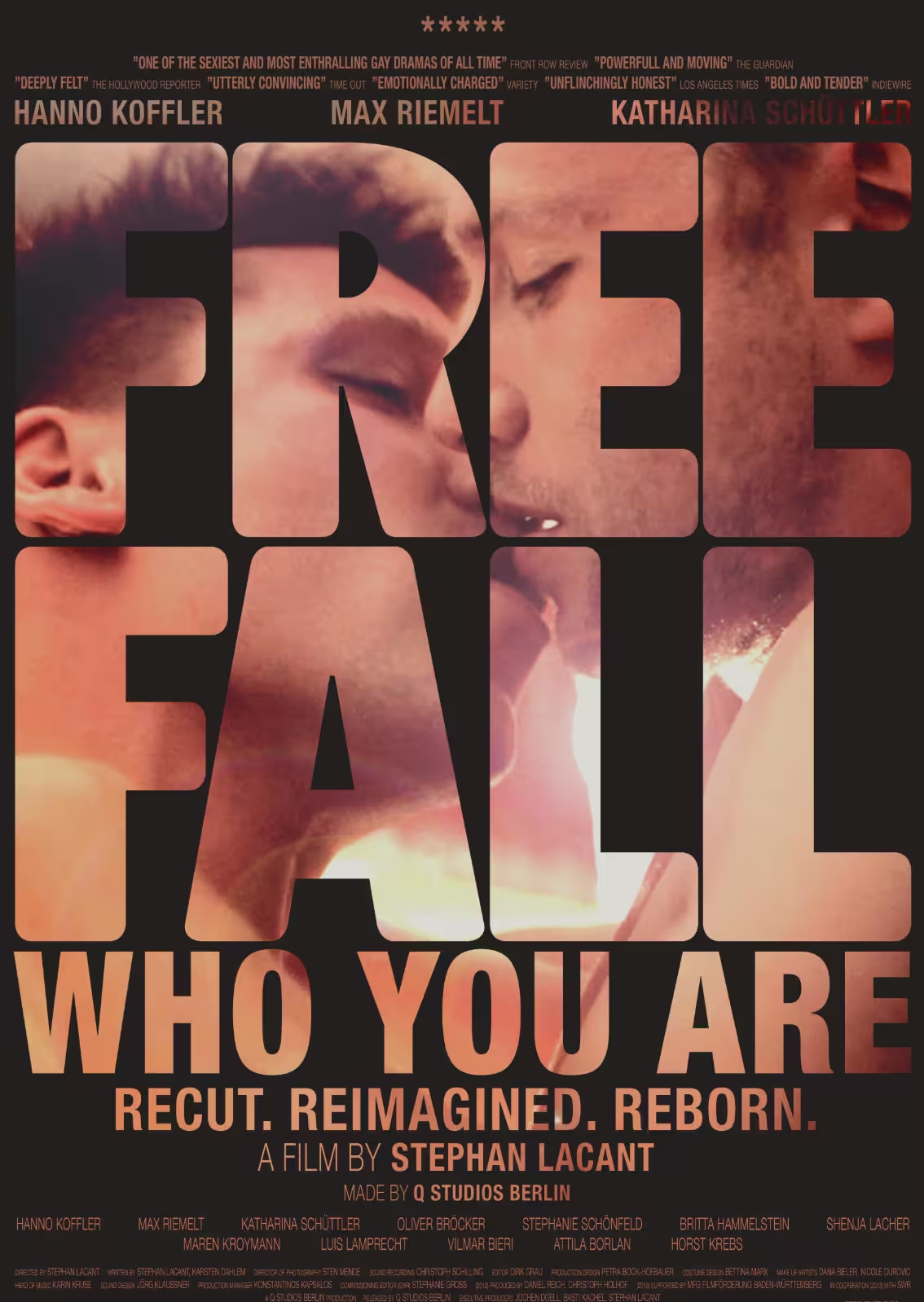
Freier Fall – Wer du bist / Free Fall – Who You Are (2026 recut of the 2013 cult film)
Industry
Media & Entertainment: Independent Film
Use case
AI voice modeling (voice cloning) to carry the original actors' vocal timbre into a new language
Languages
English launch, with additional languages planned
Technology
Deepdub voice-to-voice (V2V) AI dubbing
Freier Fall lives and dies on the closeness between its two lead characters, Kay and Marc, played by Max Riemelt and Hanno Koffler. Over twelve years, audiences have come to know those two voices as much as those two faces. For the 2026 international recut, Q Studios Berlin wasn't looking for a functional translation: they were rebuilding the film around five pillars of equal weight, including a new edit, a new sound and music design, a new visual language, 25 minutes of unreleased footage, and, critically, an English version that let global audiences meet Kay and Marc for the first time without meeting strangers wearing their faces.
That last pillar was the risk. Traditional dubbing swaps in a new voice actor, and however good the performance, something is lost: the audience is no longer hearing Kay, they're hearing an interpretation of Kay. For a film this personal, that trade-off wasn't acceptable. The brief to Deepdub was narrow and specific: preserve the actors' actual voices, in a new language, without compromising the emotional performance the story depends on.
Q Studios Berlin and Deepdub built a workflow where AI never touches raw performance; it only carries a performance that a human has already delivered. Deepdub's voice-to-voice technology sat at one precise point in a five-stage pipeline, transferring Riemelt's and Koffler's own vocal timbre onto English performances that professional voice actors had already recorded under full language and emotional direction.
The workflow, in sequence:
The result is a genuine voice-cloning use case at high fidelity: roughly 99.7% of the English dialogue runs through Deepdub's "Use Reference" voice-to-voice mode, built directly from the actors' own performances (only two supporting actors who could not give consent were replaced with library voices, for a handful of lines). For a small subset of lines, around 5%, roughly 60 lines carrying heavy sarcasm, dark humor, or a near-breaking, crying delivery, Deepdub's flexibility allowed the team to fall back to a hybrid approach and re-record those specific moments live in studio in a three-hour session, then integrate them seamlessly with the AI-modeled performance around them. Nothing about the pipeline was locked into a single mode; the team used exactly as much or as little AI as each moment demanded.
It also wasn't a plug-and-play project. The Q Studios team had access to the original, unmixed sound files from the shoot and the sound edit, which meant Deepdub's technology was applied against carefully hand-picked, nuanced source samples for each emotional beat rather than a single reference clip: a more hands-on, technical process than a typical Deepdub engagement, and one that speaks to how far the platform can flex around a production's existing assets rather than forcing them into a standard pipeline.
Skip to the action. Download a free copy ‘resource title goes here and can take entire length’

The sequencing was the whole point: emotion first, voice timbre second. Because Deepdub was never asked to generate a performance, only to carry one that a director and voice actor had already shaped, the characters kept their emotional truth in a new language. Q Studios Berlin was explicit that this mattered most in the market it was hardest to convince: even a notoriously skeptical German audience and the original actors themselves had to be won over by the quality of the result before the studio would sign off.
Cost was part of that case. Cinematic-grade dubbing of this caliber traditionally carries a steep price tag; this project came in at a fraction of that, freeing up budget for the parts of the recut that needed it most: the new sound mix in Atmos, the Foley rebuilt from scratch, and the manual, frame-accurate lip sync that AI deliberately did not touch.
Q Studios Berlin has been explicit that English is the starting point, not the destination. The studio plans to use audience and viewership data to decide which language comes next (Spanish, Portuguese, Arabic, and Hindi have all been discussed), applying the same human-performance-first, Deepdub-assisted workflow to each. For Q Studios, this project is deliberately framed as pioneering work: proof that AI dubbing can be brought in as one precisely-scoped tool inside an otherwise fully human creative process, rather than a wholesale replacement for performance, lip sync, or artistic control.
Q Studios Berlin is an independent creative ecosystem built for uncompromising storytelling and a direct connection between creators and audiences. Freier Fall – Wer du bist is its first major project: a ground-up recut of Stephan Lacant's 2013 cult film, rebuilt for an international audience across five pillars (edit, sound, visual language, new material, and AI-assisted dubbing).
Deepdub is an AI voice and dubbing company built for emotional precision. Rather than generating new performances, Deepdub's technology is designed to preserve the emotional and cultural integrity of an existing one, carrying a real performance across languages without losing the person behind it.
Breach global monetization boundaries with AI dubbing
Book a demo
Take your content anywhere you want it to be, in any language.

Signup for newsletter


© 2026 Deepdub, Inc