Real estate call volume has a shape to it that's a little unusual compared to most industries. A single leasing office might get a burst of calls right after a listing goes live, another burst on weekends when people are touring, and then near silence overnight, except for the one maintenance emergency call that always seems to come in at 11pm on a Friday. Staffing for that pattern with human agents alone means either overstaffing for the quiet hours or leaving the busy ones understaffed. It's one of the reasons voice AI has found a genuine foothold in this industry rather than just being a buzzword bolted onto a leasing office's phone system.
Where voicebots actually get used
Leasing inquiries and showing requests. A prospective tenant calls about a listing, asks about availability, pet policy, or square footage, and wants to book a showing. This is a well-defined, repeatable conversation, which is exactly the kind of call a voice AI agent handles well: it can pull listing details, check calendar availability, and confirm a showing time without a human needing to pick up.
After-hours and overflow coverage. Property management companies rarely staff a leasing desk 24/7, but calls don't stop coming in at 6pm. A voice agent can cover evenings and weekends, either answering directly or triaging urgent maintenance issues from routine questions that can wait until morning.
Maintenance request intake and dispatch. A tenant calling about a broken water heater needs different handling than one asking about the day the trash gets picked up. A voice agent that can distinguish urgency, log the details, and route to the right maintenance vendor or on-call technician cuts down on the back-and-forth that usually happens when a message gets left on voicemail and someone has to call back to get the actual details.
Multi-language leasing markets. In markets with a mix of English and Spanish-speaking prospective tenants, or wherever the local population is more linguistically diverse than the leasing staff, a voice agent that handles both languages fluently removes a real barrier, not just a convenience.
Tenant screening and application follow-up. Answering routine questions about application status, required documents, or move-in timelines is high-volume and low-complexity, which makes it a reasonable first place to introduce a voice agent before expanding into more complex conversations.
Self-serve platform or managed operation
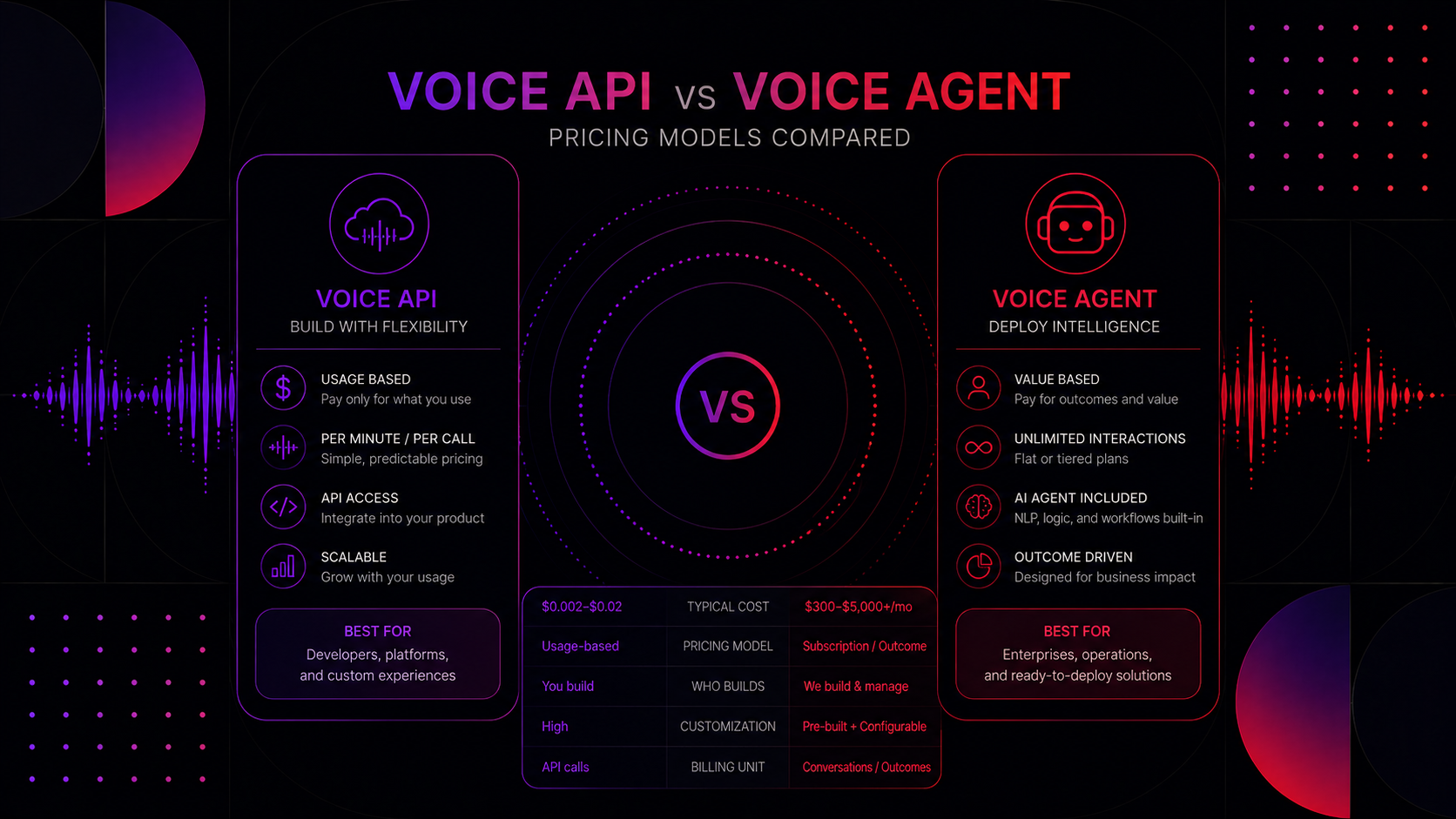
Two different models can address the use cases above, and they come with different tradeoffs.
A self-serve voice API means your team, or a systems integrator you hire, builds the call flows, connects them to your property management software, and maintains the logic over time. This gives you the most control but requires ongoing engineering or vendor-management attention.
A fully managed operation means the vendor builds, integrates, and runs the call handling directly. Deepdub's property management offering works this way: rather than selling software you configure yourself, Deepdub runs the voice operation for your portfolio, handling the integration with your existing systems and the day-to-day call handling without your team adding headcount. That's a meaningfully different purchase from a DIY voicebot platform, closer in structure to an outsourced answering service, except every call is handled by the same voice agent rather than whichever human happens to be on shift.
Which model fits depends mostly on your team's appetite for owning the technical and operational side of the system versus handing that off entirely. Portfolios with an in-house engineering or operations team that wants deep customization tend to lean toward the self-serve side. Portfolios that want the outcome without adding a new internal function tend to lean toward a managed operation.
What to check before choosing a vendor
A voicebot that sounds robotic or takes a beat too long to respond undoes a lot of the goodwill a fast answer would otherwise buy you. A few things worth verifying directly rather than taking on faith from a sales deck:
How fast does the agent start speaking after the caller finishes a sentence? Ask for the actual time-to-first-audio figure, not a vague "instant response" claim.
Does the agent handle interruptions and mid-sentence corrections the way a real caller actually talks, or does it require the caller to speak in complete, uninterrupted sentences?
If your portfolio spans multiple languages, has dialect-level quality actually been checked by a native speaker, or is language support just a checkbox based on a broader language model?
What happens when the agent doesn't understand a request? Does it escalate cleanly to a human, or does the call just loop?
What data does the vendor retain from calls, and does its compliance posture (SOC 2, GDPR alignment, and similar) match what your legal and security teams require?
On the technical side, Deepdub's voice generation streams at roughly 85 milliseconds typical time-to-first-audio, with a 150ms p95 figure for the complete real-time pipeline, in full 48kHz audio rather than the lower sample rates more common in this space. It supports 100+ languages and dialects with quality checked by in-house language experts, and can clone a consistent brand voice across languages from under three seconds of reference audio, which matters if you want the same voice answering calls in every market your portfolio operates in.
Frequently asked questions
Can an AI voicebot actually book a real showing, or does it just take a message?
It depends on the vendor and the integration depth. A voicebot connected to your scheduling and property management systems can check real availability and confirm a booking directly. One without that integration is effectively just a smarter voicemail. Ask specifically what systems a vendor integrates with before assuming either capability.
Do tenants notice they're talking to an AI, and does that matter?
Some do, some don't, and reactions vary by market and by how the call is framed. What tends to matter more in practice is whether the call actually resolves the tenant's request quickly, not whether the voice is human or synthetic.
Is this only useful for large property management companies?
It's built for portfolios with real call volume, multiple properties, and the tenant, vendor, and payment data that comes with managing units on behalf of other owners. A landlord fielding a handful of calls a week doesn't need this; a regional or third-party operator running centralized call handling across a portfolio does.
How does this differ from a generic customer service voicebot?
The conversation content is specific to real estate: listing details, showing scheduling, maintenance triage, and lease terms. A generic voicebot platform can technically be configured for this, but a vendor that already runs property management operations has the call flows and integrations built out rather than needing to be built from scratch.
Where to go from here
If you're evaluating a managed operation for your portfolio, Deepdub's property management offering is detailed at deepdub.ai/solution/property-management. Teams that want to build their own voice agent on top of a developer API instead can start at deepdub.ai/voice-api-for-agents, with full documentation at docs.deepdub.ai.
About the author

Meet the Deepdub team: a dynamic group of technology entrepreneurs, engineers, scientists, and dubbing specialists, all united by a passion for revolutionizing the entertainment industry. Our diverse expertise fuels our innovative AI dubbing and localization platform, enabling us to tackle the challenges of making content universally accessible and culturally relevant. Through our blog, we share insights and stories from our journey, showcasing the creativity and technology driving us forward. Join us in redefining the future of entertainment.